
Table of Contents
- What You’re Really Paying For: Beyond the Play Equipment
- Indoor Play Benefits for Toddlers and Young Children
- Indoor Playground Admission Price vs Membership: Making the Math Work
- How Often to Visit an Indoor Playground to Justify the Investment
- Indoor Playground vs Outdoor Playground: What You Get for Your Money
- The Hidden Value: Year-Round Access and Cleanliness Standards
- Is It Worth It? A Practical Decision Framework
- Frequently Asked Questions
Last Updated: October 12, 2026
What You’re Really Paying For: Beyond the Play Equipment
When you walk into an indoor play space, you’re not just paying for equipment, you’re asking yourself whether indoor play is worth the cost.
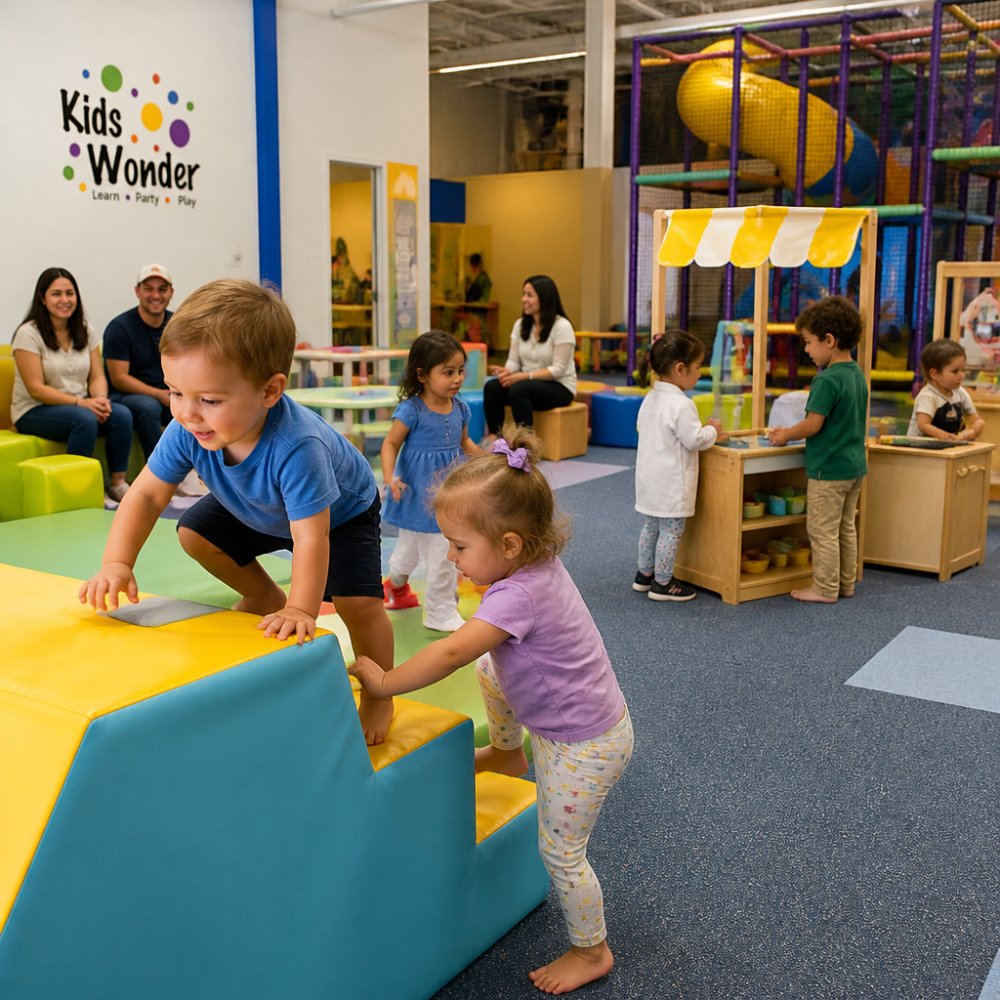
At Kids Wonder, parents often come in thinking they’re buying a way to burn energy on a rainy day. The real value shows up with regular, habitual visits, the kind that build and retain social, emotional and intellectual skills, and that takes a space intentionally designed for unstructured imaginative play, not a standard outdoor playground.
The question isn’t whether indoor play is worth the cost. It’s whether you understand what you’re actually getting.
Indoor Play Benefits for Toddlers and Young Children
Unstructured play is where real development happens, but only if it’s part of a regular, habitual routine, not an occasional rainy-day visit when your toddler is bouncing off the walls.
A single visit when your toddler is bouncing off the walls on a rainy day will burn off energy for an afternoon. It won’t build anything that lasts. Social, emotional and intellectual growth come from regular, habitual visits, the kind of repetition that lets a child practice sharing, problem solving and imaginative play in the same safe space again and again. That takes a space intentionally designed for unstructured imaginative play, which a standard outdoor playground isn’t built for.
Physical Development Through Climbing, Jumping, and Crawling
Your child’s body needs movement. Lots of it. When your toddler climbs a structure, jumps off a platform, or crawls through a tunnel, they’re building strength and coordination, testing limits and discovering what they can do. That builds confidence in a way nothing else does. Climbing builds upper body strength and coordination. Jumping develops leg power and balance. Crawling strengthens the core muscles that support posture and future athletic ability.
Indoor play spaces let your child move freely in ways outdoor playgrounds often don’t. Soft climbing structures, slides, and open spaces mean your toddler can try things at their own pace, fall safely, and get back up.
Social and Emotional Growth in a Safe Space
Your child learns how to be around other kids by being around other kids.
In an unstructured play environment, your toddler practices sharing space, reading other children’s behavior, and navigating social situations.
Confidence, emotional regulation, and the ability to get along with others are what help children thrive in school and in life.
The real value comes from showing up regularly, not from one occasional rainy-day visit. It’s the habit of going back that lets a child build and keep social, emotional, and intellectual skills over time, skills that need a space designed for unstructured imaginative play. Until they outgrow it, your child won’t tire of a well-designed, intentional play area—one that offers the kind of sustained, imaginative play a standard outdoor playground simply isn’t built to provide.
Indoor Playground Admission Price vs Membership: Making the Math Work
Most articles about indoor play either list a price and stop, or talk about benefits in the abstract. Let’s walk through the math, without pretending there’s one right answer, because the right answer depends on your family’s rhythm.
The honest way to compare drop-in admission against a membership is to think in terms of break-even visits:
- Estimate your realistic monthly visits. How many visits can you reasonably plan, for your child to realize the benefits. These aren’t just rainy day outings. Consider your family’s regular schedule and how intentional play can become part of your routine, your distance from an intentional indoor play area, the time and effort required for each visit. Also think about your child’s age, energy level, and interests—especially whether the space offers enough variety to stay engaging as they grow.
- Multiply your monthly visits by the drop-in rate. That’s your monthly drop-in spend.
- Compare that to the monthly cost of a membership or multi-visit pass. If drop-in spend is higher, the membership wins. If it’s lower, drop-in wins.
- Adjust for siblings. Many venues charge per child, so a family with three kids pays three times at the door. Memberships and family passes often have discounts for multiple children, which can change the break-even point dramatically.
A common pattern: a family with one child who visits once or twice a month may be better off with drop-in admission.
What actually changes the total cost
Admission price is only one line item. The real cost of a visit shifts based on:
- Number of children. Per-child pricing can add up.
- Adults in the party. Some venues charge for adults; many don’t. Are adults included free in the membership.
- Session length. Open-ended play versus timed sessions changes the value per visit.
- Socks. Grip socks are often required and sometimes sold at the door. Does the venue let you bring your own.
None of these are hidden in a sneaky way, they’re just easy to forget when comparing an admission number to a membership number.
The value a membership actually buys
The financial break-even is only half the story. The other half is behavioral.
When you’ve already paid for a membership, the decision to go stops being a decision. There’s no mental math on a gray Saturday, you just go. That regularity is what matters most: the social, emotional and intellectual benefits of unstructured imaginative play come from habitual visits, not an occasional rainy-day trip when the toddler is climbing the walls. A standard outdoor playground isn’t built for that kind of play, an intentionally curated indoor space is, and a membership is what turns occasional visits into a routine.
For families with kids of different ages, that friction removal matters even more.
A simple way to decide
Ask yourself three questions:
- How many times per month would we actually go? Be honest.
- How many kids would be playing? Multiply accordingly.
- How much is the ‘we can just go’ freedom worth to us?
If the drop-in math comes out close to the membership cost, the membership usually wins, it buys you permission to visit without overthinking it. If drop-in is clearly cheaper for your real frequency, start there and upgrade later.
How Often to Visit an Indoor Playground to Justify the Investment
This depends on what “justify” means to you, and whether indoor play is worth the cost for your family’s rhythm.
If it’s purely financial, you can calculate the break-even point.
Busy parents need it more often.
Parents managing multiple kids of different ages need it too.
During winter and bad weather, visits tend to increase naturally.
Think about your own rhythm. How many times per month would your family actually use this space?
Indoor Playground vs Outdoor Playground: What You Get for Your Money
Both have value. They’re not really competing.
Outdoor playgrounds are free and important. Your child should climb trees, jump in puddles, and play outside regularly, that’s irreplaceable.
But outdoor playgrounds have real limitations:
- Weather controls your schedule
- Cleanliness varies wildly (and many get minimal maintenance)
- Supervision is challenging in open spaces
- Equipment is often the same across different locations
- You can’t visit reliably in winter or on hot summer days
Indoor play spaces solve for those constraints. You can visit any day, any weather. The environment is clean and safe. Equipment is well-maintained.
The cost difference reflects this: you’re paying for consistency, safety, and reliability, not just equipment.
For families in colder climates or places with unpredictable weather, an indoor option isn’t a luxury, it’s essential for maintaining your child’s activity level year-round.
The Hidden Value: Year-Round Access and Cleanliness Standards
Two things quietly separate a well-run indoor play space from a free outdoor playground, and neither shows up in a headline price: what the space is designed to do, and how it’s maintained.
The Real Value Is in Consistent Visits, Not Occasional Ones
It’s easy to treat an indoor play space as something you turn to when the weather is bad or a toddler is restless and needs to run. That view misses where the actual benefit comes from.
The developmental value comes from regular, habitual visits. Social, emotional, and intellectual skills build and get reinforced over time, and that kind of growth needs a space intentionally designed for unstructured imaginative play, something a standard outdoor playground isn’t built to offer.
An occasional rainy-day visit won’t produce that benefit. The value is in consistency, not in just having somewhere to go when the weather doesn’t cooperate.
Cleanliness is a value factor, not a footnote
Outdoor playgrounds are wonderful, but they’re exposed to weather, wildlife, pollen, and hundreds of hands a day with no regular cleaning schedule.
A curated indoor play space operates differently. Surfaces are wiped down throughout the day, floors are cleaned on a schedule, and high-touch areas, handrails, play food, building blocks, dress-up items, get attention an outdoor structure can’t.
Kids Wonder is known for its cleanliness, and it’s something we take seriously because we’re parents too. Please note: we are not an allergen-free environment.
Year-round access changes your child’s activity baseline
In much of the country, outdoor play is genuinely unavailable for months at a time. Snow, ice, extreme cold, and even extreme heat shut down playgrounds for stretches that add up to a full season, a quarter of the year without the daily movement a toddler’s body is wired to need. But the real developmental benefit isn’t just filling that gap on bad weather days: it comes from making an indoor space designed for unstructured imaginative play part of a regular, habitual routine, not an occasional stop when the forecast turns.
An indoor space means your child doesn’t lose momentum. They keep climbing, jumping, crawling, and pretending through January the same way they do in June. Any parent who’s watched their kid bounce off the walls on day four of a snow-in understands that consistency.
The educational entertainment angle most articles miss
Here’s the part that rarely gets said out loud: a carefully curated indoor play space isn’t the same product as a playground. It’s closer to a children’s museum in spirit, built for the kind of unstructured imaginative play that grows social, emotional, and intellectual skills only when a child visits regularly, not on the occasional rainy day.
At Kids Wonder, that shows up in Lil’Town, our themed play areas where kids run a pizzeria, stock a grocery store, put out fires, care for sick pets, make coffee, board a plane, and put on a puppet show.
That’s educational entertainment in the truest sense, but it only works as a habit, not an occasional stop. Negotiation, communication, conflict resolution, and problem-solving are skills a child builds and keeps through regular visits to a space designed for unstructured imaginative play, not through one afternoon when the weather turns. A standard outdoor playground was never built for that kind of play, so an occasional rainy-day visit here misses the real benefit: it’s the routine that does the work.
Safety design as part of the value
A monitored gate, staff who check families in and out, and a policy that adults can’t enter without a playing child, those aren’t marketing lines. They’re the reason a parent can sit down for twenty minutes and actually breathe.
That’s the hidden value: not the equipment, but the design, cleanliness, year-round reliability, and the fact that you can be present without being on duty. It’s what makes regular, habitual visits realistic instead of a rare treat, and that routine is what turns unstructured imaginative play into the social, emotional, and intellectual skills a standard playground was never built to deliver.
Is It Worth It? A Practical Decision Framework
Here’s how to actually decide if indoor play is worth the cost for your family:
|
Question |
What It Tells You |
|---|---|
|
How often would we visit per month? |
Frequency determines financial break-even |
|
Do we have multiple kids needing different play types? |
Multiplies the value per visit |
|
How much do we struggle with weather-dependent activities? |
Year-round access might be essential |
|
Is our child anxious around new kids or new situations? |
Repeated visits in a safe space build confidence faster |
|
Do we need a place where we can be present but not managing? |
A well-staffed space with good sightlines is worth more |
|
How much do we value cleanliness and safety standards? |
Indoor spaces with consistent maintenance reduce stress |
If you answered “yes” to more than two of these, indoor play is probably worth it for your family.
If you’re a busy parent who needs reliable respite and you see the benefits beyond just blowing off some steam, it’s almost certainly worth it.
If you’re managing multiple kids with different needs, it’s almost definitely worth it.
If you visit occasionally during bad weather, drop-in admission might be all you need.
The real cost isn’t just the money.
That’s what makes it worth considering.
Frequently Asked Questions
Is indoor play worth the cost for toddlers?
Indoor play is worth the cost when it aligns with your family’s schedule and your child’s development stage. Toddlers benefit from the physical challenge of climbing, jumping, and crawling in a safe, controlled environment. Beyond gross motor skills, they develop confidence, learn to navigate social interactions with other children, and practice emotional regulation—skills that free outdoor playgrounds don’t systematically encourage. The cleanliness and year-round accessibility add value that outdoor spaces can’t match, especially during cold or wet weather when outdoor play becomes limited.
How often would you need to visit for a membership to be worthwhile?
Membership breaks even when your visit frequency matches your family’s typical schedule. If you visit weekly, a monthly membership usually pays for itself within 3-4 visits. For families with multiple children or those who visit during bad weather, membership often becomes cost-effective at just 2-3 visits per month. Calculate your family’s realistic visit frequency—not your ideal frequency—before committing. Remote-working parents who need a safe play space while they work often find that 1-2 visits per week makes membership economical.
What’s the difference between indoor play and a free outdoor playground?
Free outdoor playgrounds offer open space and fresh air, but indoor play spaces provide controlled environments designed for specific developmental outcomes. Indoor facilities feature thoughtfully arranged play stations that encourage imaginative play, social interaction, and problem-solving—not just physical exertion. They maintain consistent cleanliness standards, operate regardless of weather, and often include separate areas for different age groups, reducing the risk of younger toddlers being overwhelmed by older children. Outdoor playgrounds rarely receive the same level of maintenance or developmental intentionality.
When does indoor play become the better choice than outdoor alternatives?
Indoor play becomes the better choice during winter months, on rainy days, when you have children of different ages with varying play needs, or when you need a supervised space where you can also be present without distraction. It’s also the right choice when you’re seeking developmental enrichment beyond basic physical activity—spaces designed around imaginative play, social skill-building, and emotional growth deliver more than outdoor play alone. For families in areas with limited quality outdoor options or those juggling work and childcare, the year-round reliability and safety standards make indoor play a practical investment.
At Kids Wonder, we’ve built this space for families who make it part of their routine, not just a stop for a rainy afternoon. A place where your child climbs, explores, and plays with other kids, visit after visit. The real developmental value comes from this kind of regular, habitual visiting: it’s what lets your child build and retain social, emotional and intellectual skills over time, skills that need a space intentionally designed for unstructured imaginative play, which a standard outdoor playground isn’t built for. An occasional visit when the weather turns can still be fun, but it misses this point: the benefit is in the consistency. Where you can watch them grow confident and capable, time after time. Where the environment is clean, safe, and designed for real play. We’re here to support the way your family plays, week after week.