Table of Contents
- Why Safe Indoor Play for Infants Matters
- What You’ll Need for a Safe Indoor Play Session
- Step 1: Choose the Right Indoor Playground for Babies
- Step 2: Use an Indoor Play Safety Checklist Before You Go
- Step 3: Set Up Safe Play for Crawling Babies
- Step 4: Pick Indoor Activities for Babies That Match Their Skills
- Common Mistakes to Avoid with Safe Indoor Play for Infants
- Conclusion
- Frequently Asked Questions
Last Updated: October 6, 2026
Why Safe Indoor Play for Infants Matters
Safe indoor play for infants means giving babies under one year old a supervised, hazard-free space to move, explore, and build early motor skills.
At Kids Wonder, our dedicated crawler zone gives infants a safe space to play, free from the worry of being bumped or stepped on by bigger kids.
This guide breaks down how to plan a safe indoor play session, from choosing a venue to setting up your living room.
What You’ll Need for a Safe Indoor Play Session
A safe session starts with a short packing list, but the items that matter most reduce germ transfer and fall risk. Infants mouth everything, so what you bring and what you leave behind both shape the visit.
Bring these:
- A change of clothes for your baby, plus a spare for spit-up
- Socks with grips for both of you, since many play areas require them
- Hand sanitizer and wipes for surfaces and hands
- A small blanket you can lay down as a clean base
- A comfort item like a pacifier or lovey for meltdowns
- Two or three of your baby’s own toys, a teether, a soft rattle, a board book, so mouthing stays on familiar objects instead of shared ones
Leave these at home or in the car:
- Loose small toys that can roll away and become a choking hazard for another child
- Anything with a strap or cord that can wrap around a crawling baby’s neck or arm
- Bulky strollers if the venue has tight aisles, a carrier is easier to manage in a baby zone
Why the toy swap matters
Shared play equipment is a germ highway. Infants put everything in their mouths, and a toy that another child mouthed five minutes ago is now in your baby’s hands. According to CDC guidance on how germs spread in childcare settings, frequent hand cleaning and surface cleaning are the most effective steps to reduce illness in group settings, and the same logic applies to a shared play floor.
A practical routine that most parents settle into:
- Wipe your baby’s hands when you arrive and again before you leave.
- Keep your own toys in a separate pouch so they do not mix with venue toys.
- If your baby is in the mouthing stage skip the ball pit and shared plush toys.
- Wash hands with soap and water as soon as you get home, before feeding.
When to skip the visit entirely
Some days are not play-space days. Stay home if your baby has a fever, is teething with drooling and irritability, has a runny nose with colored discharge, or has had diarrhea in the last 24 hours.
Before you leave, check the venue’s rules. Many indoor playgrounds post age policies, sock requirements, and cleaning schedules online. A quick call saves a wasted trip, and it is fair to ask how often the infant area is wiped down.
Step 1: Choose the Right Indoor Playground for Babies
The best indoor playground for babies has a physically separate area for children under two. Separation matters more than size, price, or location.
Here is what to look for:
- A dedicated baby area with its own boundary, not just a corner of the main floor
- Soft play surfaces like padded mats or foam flooring
- Low climbing structures sized for crawlers and cruisers
- Age separation so infants are not mixed with older kids
- Clear sightlines so you can watch your baby from a seated spot
Ask how the venue handles crowding. A space that caps attendance or staggers sessions keeps the baby area calm; one that lets everyone in at once does not.
Kids Wonder built its crawler zone for exactly this reason, with a separate space for children two and under away from the inflatables and Lil’Town structures. Parents tell us the separation is the difference between a relaxing visit and a stressful one.
Step 2: Use an Indoor Play Safety Checklist Before You Go
An indoor play safety checklist is a quick pre-visit routine that catches hazards before your baby hits the floor. Run through it every time, even at a venue you know well.
- Confirm the venue’s age policy and hours for the day
- Check that the baby area is separate from older kids
- Look for padded flooring and covered outlets
- Scan for small objects, loose parts, or broken equipment
- Make sure a caregiver can sit within arm’s reach
- Verify hand-washing or sanitizer stations are available
- Ask staff how often equipment is cleaned
The cleaning question matters more than most parents think. According to CDC guidance on how germs spread in childcare settings, frequent hand cleaning and surface cleaning are the most effective steps to reduce illness.
If a venue cannot answer basic hygiene questions, that is your answer. Move on.
Step 3: Set Up Safe Play for Crawling Babies
Safe play for crawling babies comes down to three things: a clear path, a soft landing, and you within reach. Set those up and your baby can explore without constant correction. The setup should change as your baby moves from rolling to sitting to crawling to cruising.
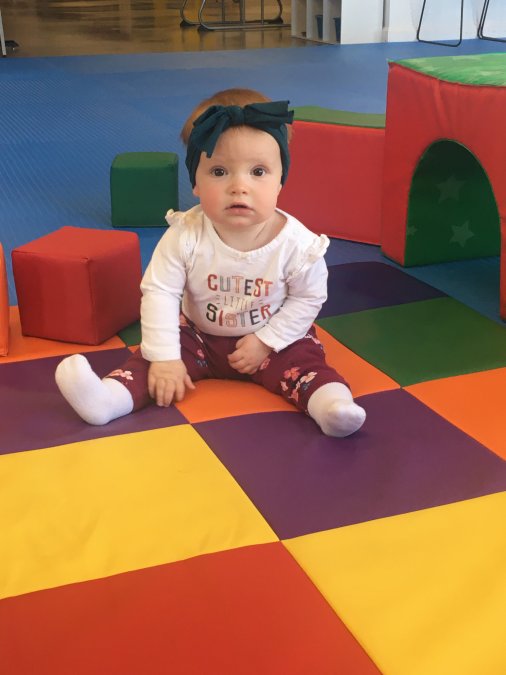
A parent sitting cross-legged on a soft padded mat in a bright indoor play area, watching a baby in a onesie crawl toward a colorful soft toy, with foam climbing blocks and a low barrier in the background
Match the setup to the stage
|
Stage |
Typical Age |
What the Space Needs |
What to Remove |
|---|---|---|---|
|
Rolling |
4-6 months |
Firm mat, tummy-time mirror, no incline |
Pillows, soft bedding, bouncers |
|
Sitting |
6-9 months |
Padded floor, low ring of soft blocks for support |
Hard-edged furniture within reach |
|
Crawling |
8-11 months |
Continuous mat, clear 6-foot path, low barrier at stairs |
Cords, small objects, pet bowls |
|
Cruising |
9-12 months |
Stable low bar or sofa edge, soft landing zone |
Wobbly tables, glass, sharp corners |
Clear the path
Start by clearing the space. Move toys, bags, and shoes out of the crawling path. Babies pull up on whatever is nearby, so anything unstable should go, a floor lamp, a folding chair, a stack of books. A crawling baby can cross a room in seconds, so the path must be clear end to end.
Check the edges and the floor
Then check the edges. Cover sharp corners, block stairs with a gate or firm cushion, and keep cords out of reach. Get down on the floor and look from your baby’s height, you will spot hazards an adult view misses: a dangling cord behind the couch, a coin under the coffee table, a pet bowl within reach.
Set up safe play at home
You do not need a commercial play space to give a crawler a safe session. A living room works if you set it up deliberately:
- Lay a firm mat over carpet or rug so the surface is consistent. A folded quilt is not firm enough for tummy time or pulling up.
- Use a play yard as a boundary, not a cage. A six-panel yard gives a crawler a defined zone while you cook or fold laundry nearby.
- Anchor furniture to the wall if your baby is pulling up. A dresser or bookshelf that tips is the most serious fall risk in a home play area.
- Cover outlets and tuck cords behind furniture.
- Rotate toys every few days so the space stays interesting without becoming cluttered.
Know the fall-risk math
Most infant injuries at play spaces and at home happen when a caregiver steps away. A baby who just learned to pull up is highest-risk because they can get up but cannot reliably get down. That is why “within arm’s reach” is not a suggestion, it is the single control that prevents the most common injury.
Crowding and age separation
At a venue, ask two questions before your baby hits the floor: Is the infant area physically separated from older kids, and does the venue cap attendance or stagger sessions? A separate zone with a low barrier and a staff member at the entrance is the gold standard; a corner of the main floor with a sign is not. Weekday mornings right after opening are the quietest window and easiest time to supervise.
Step 4: Pick Indoor Activities for Babies That Match Their Skills
The right indoor activities for babies match where your child is right now, not six months from now. A baby who just learned to roll needs something different from one pulling to stand.
|
Stage |
Typical Age |
Good Activities |
What to Avoid |
|---|---|---|---|
|
Rolling |
4-6 months |
Tummy time on a mat, reaching for soft toys |
Bouncers and containers |
|
Sitting |
6-9 months |
Sitting with support, batting at hanging toys |
High climbing structures |
|
Crawling |
8-11 months |
Crawling through tunnels, chasing soft balls |
Ball pits with older kids |
|
Cruising |
9-12 months |
Pulling up on low bars, pushing walkers |
Slides and tall equipment |
Match the activity to the stage and your baby stays engaged instead of frustrated. Push too far ahead and you spend the visit rescuing them.
A common mistake is treating a ball pit as baby-friendly. It is not, unless it is a separate infant pit.
Common Mistakes to Avoid with Safe Indoor Play for Infants
Most problems at indoor play spaces trace back to five avoidable mistakes. Fix these and visits get easier.
- Arriving at peak hours. Crowded baby areas mean more bumps and less space to crawl.
- Forgetting socks. Many venues require them, and bare feet on shared floors is a hygiene problem.
- Letting your baby mouth shared toys. Bring a few of your own toys to reduce germ exposure.
- Ignoring your baby’s cues. An overtired or hungry infant will not enjoy play, no matter how good the space is.
Conclusion
Finding safe indoor play for infants takes a little planning, but the payoff is a baby who gets to move, explore, and build skills in a space built for them.
That is exactly what we built at Kids Wonder.
Ready to give your baby room to explore? Book a party or plan your first drop-in visit with Kids Wonder and see the difference a space designed for their stage makes.
Frequently Asked Questions
How can I make indoor play safe for an infant?
Start by choosing a space with a dedicated baby area and soft play surfaces. Keep the area free of small objects and ensure constant supervision. Use our indoor play safety checklist to verify that outlets are covered, furniture is anchored, and toys are age-appropriate. For public spaces, confirm they have a separate crawler zone and clean equipment.
What should I look for in an indoor playground for babies?
Look for a separate baby area with soft play surfaces, age-appropriate climbing structures. Check that the space is clean and well-maintained. Ask about age separation and crowding policies. A dedicated crawler zone for children under two is ideal, as it reduces the risk of bigger kids knocking them over.
What activities are safe for infants indoors?
Safe indoor activities for babies include crawling on soft mats, exploring textured toys, and pulling up on low climbers. Avoid activities with small parts or rough play. For crawling babies, create a clear path with soft obstacles to encourage movement. Always supervise and ensure toys are free of choking hazards.
How should I supervise a baby during indoor play?
Stay within arm’s reach of your baby at all times, especially in public play areas. Watch for hazards like older children running, sharp edges, or small objects on the floor. Use a safety checklist before each visit. If you need to step away, place your baby in a safe container like a playpen or stroller. Never rely on older children to supervise.