Table of Contents
- Why Today Matters for Toddler Adventures
- Indoor Activities for Toddlers: Your Weather-Proof Haven
- Free Toddler Activities Near Me: No Budget Required
- Toddler Events Near Me: Community Celebrations and Gatherings
- Activities for 2-Year-Olds: What They’re Ready For
- Making the Most of Your Toddler Outing Today
- Celebrate Today: Birthday Parties and Special Moments
- Conclusion
- Frequently Asked Questions
Last Updated: October 11, 2026
Why Today Matters for Toddler Adventures
Your toddler wakes up with energy. They’re ready to move, explore, and play.
When you search for toddler activities near me, you’re looking for more than entertainment. You want a safe space where your child can grow, be present without stress, and experience real play that matters.

At Kids Wonder, we’ve watched families discover what happens when you give toddlers space to play freely, your child builds confidence, solves problems, makes friends, and you witness all of it.
Indoor Activities for Toddlers: Your Weather-Proof Haven
Rain, snow, or heat, weather shouldn’t stop your child from playing. Indoor activities for toddlers give you a reliable option no matter what’s happening outside.
Indoor play spaces are built for toddler-sized bodies and attention spans. Your child can run full speed, climb safely, and be loud without disturbing neighbors. That freedom matters.
What Makes Indoor Play Different
Indoor play isn’t just outdoor play moved inside. It’s designed specifically for how toddlers learn and grow.
Toddlers need soft surfaces to land on, age-appropriate challenges, multiple play styles, climate control, and other kids around to practice social skills naturally.
Free Toddler Activities Near Me: No Budget Required
Not every family has money for activities today. That’s real. But your child still deserves to play.
Many communities offer free or low-cost toddler activities near me. The challenge isn’t finding them, it’s knowing which ones are actually happening today, whether they’re crowded, and whether they’ll work for your toddler’s needs.
Free and Low-Cost Options That Actually Work for Toddlers
Library story times are reliable and free. Most public libraries offer toddler storytimes during weekday mornings or weekend afternoons.
Public parks with toddler play areas are free but uncontrolled, metal slides burn in heat, wet equipment gets slippery in cold, and when was the last time they were cleaned?
Community center open play varies by location. Some offer dedicated toddler hours; others mix all ages. Call ahead to ask: Is open play happening today?
Splash pads in summer are usually free. Check your city parks website for locations and hours.
Nature centers and easy walking paths often have free admission. Toddlers love exploring dirt, rocks, and leaves. Choose stroller-friendly terrain.
Museum free hours happen occasionally. Check your local museum’s website. Arrive early, toddlers do better during the first 30 minutes before crowds form.
The Real Trade-Off: Free vs. Safe and Predictable
Free activities are wonderful but unpredictable. When you need guaranteed safe play space today, when your toddler can get tired or overstimulated, dedicated indoor play spaces deliver consistency and predictability. Use free options when you have time to scout and your child is flexible. Use dedicated play spaces when you need safety and peace of mind.
Toddler Events Near Me: Community Celebrations and Gatherings
Your toddler doesn’t need a fancy event to have fun. They need other kids. They need to move. They need to feel like they belong. But finding toddler events near me today means knowing where to look and what actually works for your child’s temperament.
Where Toddler Events Happen (And How to Find Them Today)
Library and bookstore story times are reliable recurring events, typically 20-30 minutes, perfect for toddler attention spans. Most libraries offer multiple times per week.
Seasonal festivals and community fairs are free or low-cost but crowded and loud. Arrive early to beat crowds. Bring noise-reducing headphones if your toddler is sound-sensitive.
Farmer’s markets with kids’ activities happen weekly during growing season. Many feature kids’ corners with crafts or music. Markets are less crowded than festivals and more sensory-friendly.
Music classes and sing-alongs at community centers, parks, or libraries are often free and shorter than story times (15-20 minutes).
Holiday celebrations and community gatherings at parks or town squares are free and family-focused. Arrive very early to avoid crowds. Bring a blanket, snacks, and water.
What Actually Works for Toddlers at Events
Toddlers are there to move, explore, and feel included, not to “see the whole thing.” Timing matters: mid-morning or early afternoon works best, never right before nap time. Sensory load is real: loud events overwhelm sensitive toddlers; quieter gatherings work better. Arrive early to beat crowds and leave before your child gets cranky. Your presence is the point: your toddler watches other kids, hears different voices, and sees families like yours. That’s the real value. Establishing these rhythms of engagement creates a sense of security that carries over into the quiet ritual of bedtime stories for toddlers.
When to Skip the Event (And What to Do Instead)
Not every event works for every toddler. If your child is sick, tired, or in a difficult mood, skip it. A meltdown at a crowded event stresses everyone. Your toddler learns that events are overwhelming. You feel like you failed. Nobody wins.
On those days, a quieter activity, a walk in the park, time at a dedicated play space, or unstructured play at home, is a better choice. Your toddler gets what they need. You stay calm. That’s a successful day.
Building Community Without the Event Chaos
Kids Wonder hosts playdates and community gatherings throughout the year in a space designed specifically for toddlers. It’s not a crowded festival or a formal event. It’s families coming together in a safe, predictable space where kids play and parents connect. No sensory overload. No crowds. No stress. Just real community, the kind that actually matters for families with toddlers.
Activities for 2-Year-Olds: What They’re Ready For
Two-year-olds are wild. They’re curious. They’re testing every boundary. And they’re ready for more than you might think.
Activities for 2-year-olds should include:
- Climbing (they love it, and it builds strength)
- Running (full speed, no stopping, just joy)
- Pretend play (they’re starting to imagine, not just imitate)
- Playing with other kids (they don’t share yet, but they learn by being near others)
- Sensory play (blocks, balls, things that move and make noise)
- Simple problem-solving (fitting shapes, stacking, pushing buttons)
Toddlers are too big for the baby area but not quite ready for the older kid places. They need a space designed for their exact stage.
Safety and Separation: How Kids Ages 6 Months to 6 Years Play Together
Your 2-year-old is brave, sometimes too brave. They’ll run toward a 5-year-old on the inflatables and get knocked over. That’s not safe for either child. Kids Wonder solves this by giving every age its own space, so siblings can still play under one roof.
Spaces built for each stage
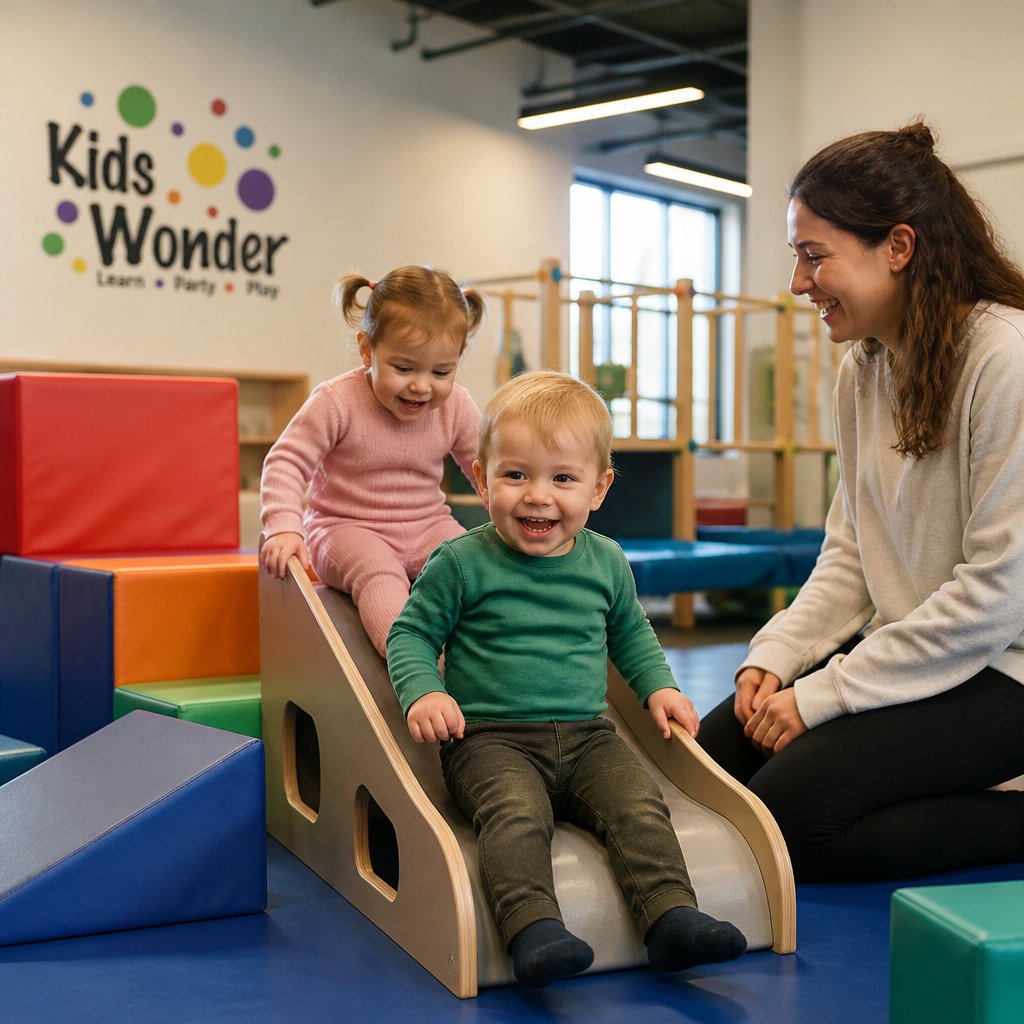
- Crawler area (2 and under): A restricted zone for crawlers and early walkers. It has soft play mats for climbing and crawling, a baby mirror, manipulatives, a ball pit, and a tiny slide. Bigger kids stay out, so your baby can explore at their own pace.
- Small inflatable (2 and under): A bounce house sized for the youngest guests, so they get the fun of bouncing without the big-kid crowd.
- Lil’Town (all ages): Our 17 imagination stations include a Pizzeria, Grocery Store, Fire Station, Vet, Airport, and more. Toddlers who are just learning to walk push shopping carts and strollers, while 2–6-year-olds build, cook, and role-play. Staff monitor the area so kids walk instead of run and play safely around younger children.
- Whole Body Play (ages 3–6): Large inflatable bounce houses and Whole Brain Blocks give older kids room to move, climb, and build. They can burn energy here without a toddler in their path.
What this means for your family
- Your 2-year-old plays at their own speed.
- Bigger kids don’t accidentally knock them over.
- You can see everything without constant anxiety.
- Your child builds confidence in their own space.
- Moving up to bigger play areas happens naturally when they’re ready.
Kids Wonder’s design offers each child an area built for their size and energy level. Your baby crawls, your toddler pretends, and your 6-year-old bounces, all in a secure gated area. You watch your child master new skills and try things they’ve never done before. You’re present for all of it.
Making the Most of Your Toddler Outing Today
You’ve found toddler activities near me today. You’ve packed the diaper bag. Now what?
The best toddler outings aren’t about doing everything. They’re about letting your child play until they’re ready to stop.
Here’s what actually works:
- Arrive when your child is rested (not right before nap time)
- Plan for at least 45 minutes of play (less feels rushed)
- Let your child choose what to play with
- Don’t try to make them do every activity
- Watch them, actually watch them, not your phone
- Stay as long as they’re engaged
What to Bring and How Long to Stay
You don’t need much. Seriously. Your child needs to move. They need to play. They don’t need fancy gear.
Bring:
- Water (kids get thirsty when they play)
- Comfortable clothes your child can move in
- Socks or shoes (depending on the space)
- Wipes (for hands after play)
Time to stay:
- Under 2 years: 45 minutes to 1 hour
- 2 to 3 years: 1 to 1.5 hours
- 3 to 4 years: 1.5 to 2 hours
- Older toddlers: as long as they want to play
The goal isn’t to tire them out completely. It’s to let them play, rest when they need to, and play again. Watch your child. When they start getting cranky or clingy, it’s time to go. A good outing ends while your child still wants more.
Celebrate Today: Birthday Parties and Special Moments
Today might be your child’s birthday. Or your niece’s. Or a friend’s kid. Whatever the reason, celebrating matters.
Birthdays deserve to happen in a space that honors childhood. Not a space that stresses you out with setup and cleanup. Not a space where you’re worried about your child’s safety. A space built for joy.
Kids Wonder’s birthday party experience means:
- Your child gets celebrated in a place they love
- Our coordinators handle everything
- You skip the stress and just show up
- Your child makes memories with friends
- You actually get to enjoy the celebration
No setup. No cleanup. No wondering if everything will work out. Just your child’s face lighting up. That’s what a birthday should be.
Conclusion
Your search for toddler activities near me today started with a simple question: Where can my child play?
The real answer is deeper. Your child needs a space where they can be themselves. Where they can try things. Where they can fail safely. Where they can build the confidence that comes from real play.
At Kids Wonder, that’s exactly what we’ve created. A place where your toddler climbs, explores, pretends, and grows. A place where you can be present without stress. A place where families actually belong.
Your child’s play matters. Today matters. Come discover what happens when you give your toddler the space to wonder.
Book a party now or explore our membership options to make today unforgettable.
Frequently Asked Questions
What should I bring when taking my toddler out for activities today?
Pack a small backpack with water, snacks, a change of clothes, and wipes. Bring your phone for photos and emergencies. If your toddler wears diapers, pack extras. Comfortable shoes for your child help them move freely. Many indoor play spaces have cubbies to store belongings. A small toy or comfort item can help if your child gets overwhelmed. Most importantly, bring your presence and patience—your calm energy sets the tone for their adventure.
How can I find free toddler activities near me?
Many communities offer free toddler activities through libraries, parks, and community centers. Check your local library website for storytimes and toddler programs. Parks often have age-appropriate play equipment at no cost. Community centers sometimes host free playdates or parent-child meetups. Ask neighbors and other parents about hidden gems in your area. Social media groups for local parents often share free activities happening today. Some indoor play spaces offer occasional free play hours or community events.
What makes a toddler activity right for my child’s age?
Consider your child’s physical abilities, attention span, and comfort with new situations. For children under 2, look for spaces with separate crawler zones and soft play areas. Two-year-olds thrive with climbing, sliding, and pretend play. Three-year-olds enjoy more interactive activities and group play. Watch for activities that don’t require sitting still for long periods. Choose spaces where your child can explore independently while you stay close. Trust your instincts—if your child seems overwhelmed, it’s okay to leave and try something gentler.
How long should a typical toddler outing last?
Most toddlers thrive with 45 minutes to 90 minutes of active play, depending on age and energy level. Younger toddlers (under 2) may do better with shorter 30-45 minute sessions. Two and three-year-olds often enjoy 60-90 minutes before fatigue and overstimulation set in. Watch for signs your child is ready to leave: rubbing eyes, increased whining, or loss of interest. End on a positive note rather than waiting for a meltdown. Remember, a happy short outing beats a long one that ends in tears. Your child will be ready for a snack and quiet time afterward.